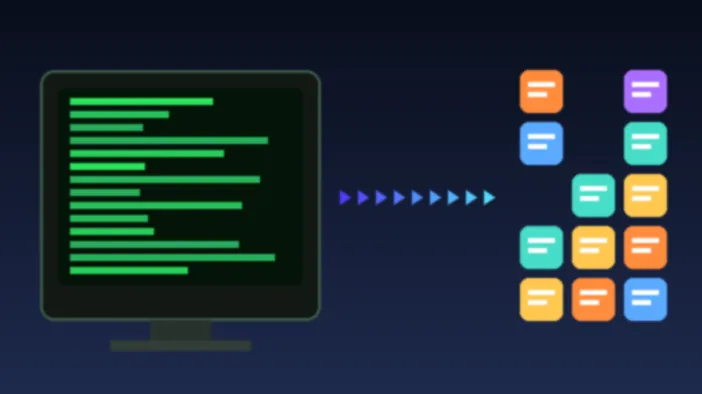
OpenAI says its models have made a big jump on languages long treated as legacy: COBOL, Fortran and Visual Basic. Bank settlements, insurance systems and government registries still run on them, while the number of people who can maintain that code keeps shrinking.
The headline number is 97.9%: that is the share of COBOL translation tasks where GPT-6.1 Sol produced a modern version that behaved exactly like the original. A model generation ago, the same test was passed only in a handful of cases.
Why legacy code is hard to port
Models lack training material: there is little open COBOL code, documentation for corporate systems is often lost, and the original authors left long ago. Business rules frequently live only in the source itself. So rewriting the syntax is not enough - every detail has to survive: how amounts are rounded, what happens to empty records, in which order calculations run.
What the tests showed
OpenAI built a benchmark called MultiLangBench, where a model has to write a SQLite-compatible database engine from scratch in one of 20 languages. A separate test covers porting COBOL programs to C++, Java, Kotlin, Python and Rust with fully identical behavior.
- GPT-6 Astra at maximum reasoning: 87.4% on average in MultiLangBench versus 26.8% for GPT-5.6 Sol;
- COBOL rose from 10.9% to 72.1%, Fortran from 21.4% to 83.5%, Visual Basic from 27.5% to 89.4%;
- GPT-6.1 Sol on COBOL porting: 86.6% even at minimal reasoning and 97.9% at higher settings;
- the cheaper GPT-6 Luna scored 40.3%, but a task via the API cost about $0.77 instead of $3.48.
The mainframe race
OpenAI is not first here: back in February Anthropic said Claude Code could take over part of the analysis and updating of legacy software, and IBM shares, whose mainframes run such programs, dropped noticeably afterwards. Modernizing old systems is a huge market, and AI companies clearly see it as one of the most lucrative uses for their models.
Our take
The numbers are impressive, but they come from OpenAI's own test, and a real bank has no ready-made suite that proves a migration worked. The most valuable part of such projects is tests that pin down how the old system behaves, and AI is more likely to speed up people's work than replace it. Details are in the 3DNews report.